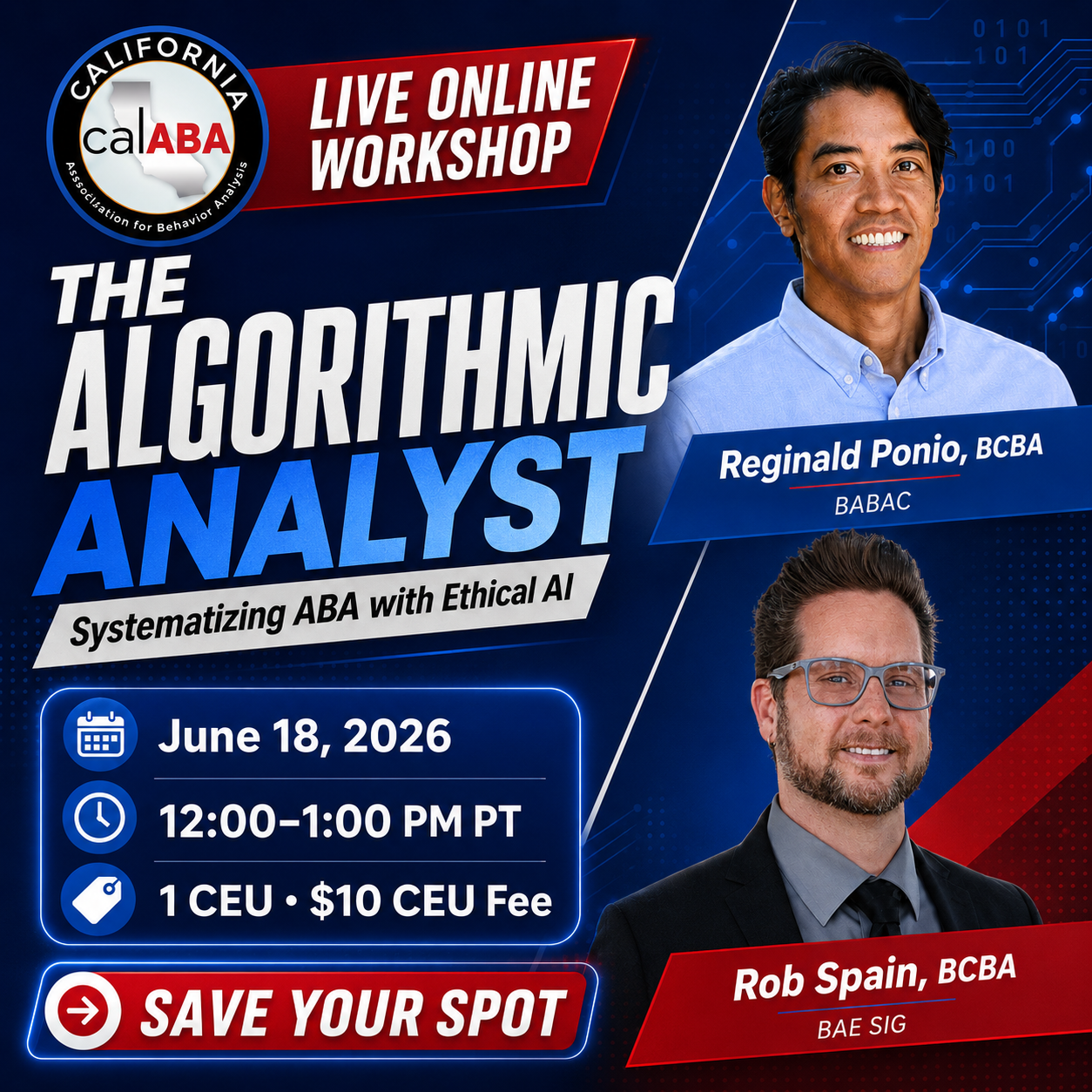
FREE CEU Event "Systemizing ABA with Ethical AI"
Don’t miss this
FREE CEU event!
Thursday, June 18th, 12:00 noon PDT
Live online at Behavior Live!
This event
will be recorded and available on-demand for existing registrants.
Register now, and access it live or on-demand for CEUs.
Artificial intelligence is increasingly embedded in applied behavior analysis service delivery, yet practitioner-level guidance on its ethical and practical implementation remains limited. This workshop addresses that gap by providing ABA business owners, school-based practitioners, and case managers with a structured framework for building and applying custom AI tools to clinical and business workflows.
The presentation is organized around three components. The first establishes the ethical foundation for AI use in ABA, drawing on HIPAA and FERPA requirements, the BACB Ethics Code, and the principles described by Jennings and Cox (2023). Two non-negotiable standards are emphasized: the exclusion of personally identifiable information (PII) from public large language models, and the application of clinical judgment to all AI-generated output. The distinction between PII (e.g., name, contact information, identifiers) and contextual variables permissible for generative language model use (e.g., age, diagnosis) is operationalized for everyday practice.
The second component demonstrates the development and use of custom AI tools built on platforms including Claude, Claude Code, Gemini Gems, and custom GPTs. Examples include a business operations dashboard, a function-based assessment and behavior intervention planner, an IEP goal generator aligned to Common Core standards, and an eLearning platform for continuing education and supervision.
The third component examines the implications of these tools for clinical reasoning. AI is positioned as a thinking partner that supports clinicians in formulating sharper clinical questions, integrating current research into individual client cases, and reducing the practice-to-research gap that has long characterized the field.
Learning Objectives:
- Participants will identify or describe the ethical guardrails for AI use in ABA practice, including the PII/PHI distinction, HIPAA/FERPA boundaries, and the human-oversight standard.
- Participants will describe or capture how the presenters have used AI beyond more generalized chatbot function.
- Participants will state how the presenters used AI to build specific tools and protocols specific to their area of expertise
- Participants will apply a build-plan approach to outline how customizable tools or protocols for their specific areas of practice
- Participants will evaluate the role of AI as a thinking partner in bridging the practice-to-research gap.